Experience the perfect balance of performance and price with the new Mimosa C6x Lite Edition — built for today, ready for tomorrow.

Network Orbiter put the Mimosa C6x to the test across an extraordinary 153.31 km line-of-sight wireless backhaul link. Paired with Network Orbiter’s OANT36-4MH-X high-gain parabolic antenna, the deployment achieved stable connectivity and 780 Mbps PHY throughput — demonstrating what’s possible when high-performance wireless technology meets precision RF engineering.
153.31 km Long-Distance Wireless Backhaul
Network Orbiter conducted a field deployment to validate the performance of the Mimosa C6x across an ultra-long-distance point-to-point link. The objective was to establish reliable, high-capacity connectivity while maintaining consistent signal quality, modulation and throughput across the entire 153.31 km route.
Deployment: Long-Distance PTP Backhaul
Distance: 153.31 km
Radio: Mimosa C6x
Antenna: Network Orbiter OANT36-4MH-X
Channel Bandwidth: 160 MHz
Reliable Performance Across an Extreme Distance
Establishing a wireless link exceeding 150 km required careful engineering to overcome significant propagation and deployment challenges.
The solution needed to address:
The goal was not simply to establish a connection, but to maintain reliable, high-capacity performance across an exceptionally long wireless path.
Mimosa C6x + High-Gain Antenna Engineering
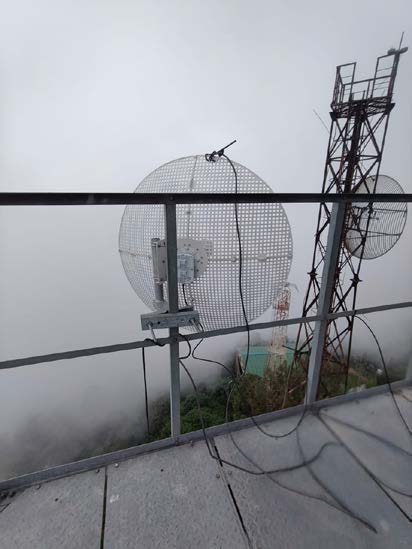
Network Orbiter combined Mimosa C6x high-capacity wireless radios with its OANT36-4MH-X high-gain parabolic antenna to engineer the 153.31 km link.
Detailed path analysis and line-of-sight verification were used to plan the deployment, followed by precise antenna alignment and spectrum analysis to identify suitable operating channels.
The OANT36-4MH-X antenna's high gain and directional characteristics helped maximize signal integrity and reduce susceptibility to external interference, while the Mimosa C6x provided the high-capacity wireless platform needed for the long-distance backhaul connection.
780 Mbps Across 153.31 km
Field testing successfully validated high-capacity connectivity across the full link.
153.31 km
Line-of-sight wireless link
780 Mbps
Sustained PHY throughput
-69.3 dBm
Stable RSSI
MCS 204
Reliable modulation performance
Testing also demonstrated stable association and link uptime, successful uplink and downlink traffic, low end-to-end latency and reliable packet delivery — even while operating in a heavy-interference environment.
Network Orbiter is a wireless networking and system integration company specializing in high-performance wireless access and backhaul solutions. The company combines advanced wireless radio platforms with its own antenna technologies and is also an authorized Value-Added Distributor of Mimosa solutions.
For this deployment, Network Orbiter set out to validate reliable wireless connectivity across a 153.31 km line-of-sight route — a distance that presents substantial challenges for any wireless system.
The deployment used the Mimosa C6x, a high-capacity wireless radio designed for point-to-point and point-to-multipoint applications, paired with Network Orbiter's OANT36-4MH-X Full Parabolic Dish Antenna.
The antenna was selected specifically for ultra-long-range backhaul applications, providing high-gain signal concentration, strong directional performance and reduced susceptibility to external interference.
Long-distance wireless performance depends on far more than radio specifications alone.
At more than 150 km, free-space path loss, terrain, antenna alignment, interference and frequency planning can all significantly affect link performance. Elevation profile analysis identified multiple terrain variations along the route, making accurate path engineering essential.
Network Orbiter conducted detailed path analysis and line-of-sight verification before deployment. Antennas were installed on ground-based structures at heights of approximately 15 meters and 25 meters, with precise alignment procedures used to maximize signal integrity.
Spectrum analysis was also conducted to identify suitable operating channels and optimize performance.
The resulting solution combined:
The deployment successfully established and maintained connectivity across the entire 153.31 km wireless path.
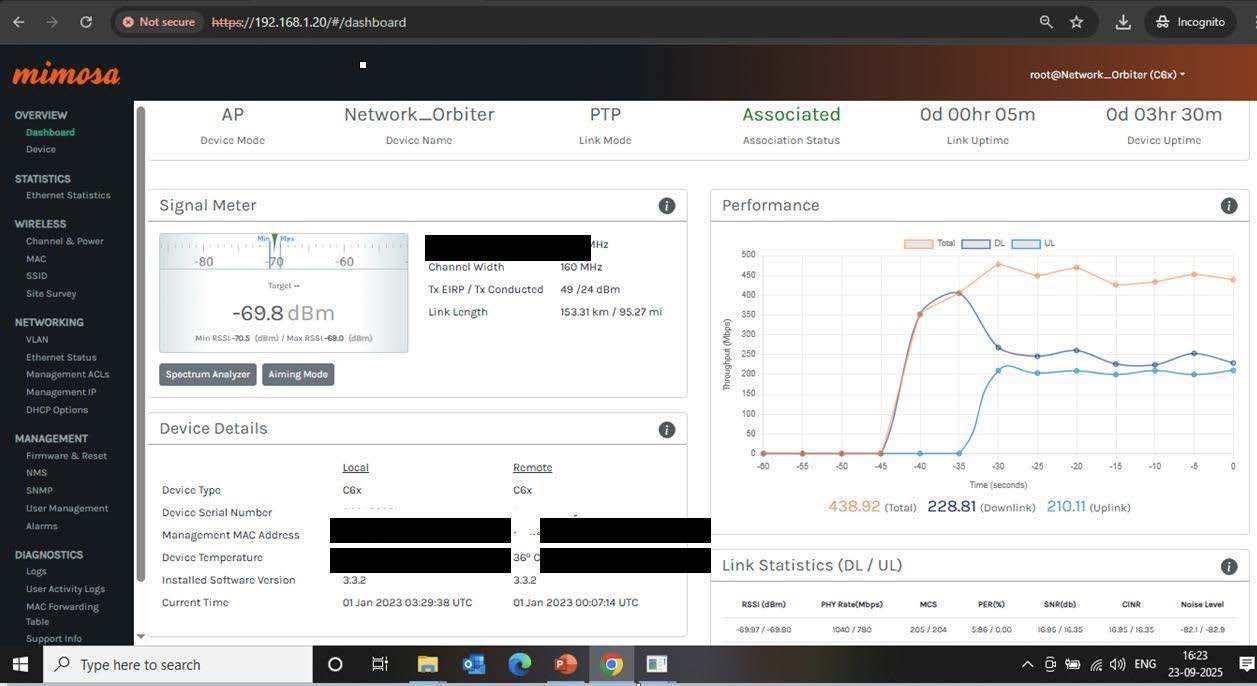
Field testing recorded a stable RSSI of approximately -69.3 dBm, reliable MCS 204 modulation, and sustained 780 Mbps PHY throughput.
Bandwidth and JPerf testing further validated the link's ability to support high-capacity data transport. Testing demonstrated consistent signal levels, stable association, successful uplink and downlink traffic, low end-to-end latency and reliable packet delivery.
Importantly, the link maintained performance while operating in a heavy-interference environment, further demonstrating the importance of combining capable radio technology with proper antenna selection and RF engineering.
Deploying fiber across extremely long or difficult routes can introduce substantial infrastructure costs, right-of-way requirements and lengthy construction timelines.
This deployment demonstrates another option.
By combining the Mimosa C6x with Network Orbiter's high-gain antenna technology and careful RF engineering, Network Orbiter established a reliable, high-capacity wireless connection across more than 153 kilometers.
The result demonstrates how modern fixed wireless backhaul can extend connectivity across distances where conventional infrastructure may be difficult, slow or economically challenging to deploy.
Experience the perfect balance of performance and price with the new Mimosa C6x Lite Edition — built for today, ready for tomorrow.