Experience the perfect balance of performance and price with the new Mimosa C6x Lite Edition — built for today, ready for tomorrow.

Working with Asia Quattro Net (AQN) and Telkomsel, Mimosa helped extend broadband connectivity across remote island communities in Indonesia using long-distance fixed wireless backhaul. Faced with difficult terrain, water crossings, and the high cost of traditional infrastructure, the deployment delivered a scalable and cost-effective alternative to satellite connectivity.
Indonesia’s geography presents one of the world’s most challenging broadband deployment environments. Spanning more than 16,000 islands across thousands of kilometers, many rural and remote communities remain difficult to connect using traditional wired infrastructure.
To help expand connectivity into underserved regions, Asia Quattro Net (AQN) partnered with Telkomsel to deploy a high-performance wireless backhaul solution capable of overcoming water crossings, remote terrain, and infrastructure limitations. The goal was to improve broadband access while reducing the cost and complexity associated with satellite and fiber deployments.
Mimosa’s fixed wireless technology enabled rapid deployment of long-distance point-to-point links, helping deliver reliable broadband services to communities where traditional infrastructure approaches were either too costly or too slow to implement.
Telkomsel and Asia Quattro Net (AQN) needed a scalable and cost-effective way to expand broadband connectivity into remote island and coastal regions across Indonesia. Traditional fiber deployment was often impractical due to geography, cost, and deployment complexity, while satellite backhaul introduced limitations around latency, scalability, and ongoing operational expense.
Key project requirements included:
To address these challenges, AQN and Telkomsel deployed Mimosa’s high-performance fixed wireless backhaul platform to create reliable long-distance point-to-point connectivity between aggregation sites and remote base stations.
The deployment leveraged:
While the deployment utilized Mimosa C5x radios, the focus of the project centered on delivering practical, high-performance broadband connectivity in areas where traditional infrastructure approaches were difficult or uneconomical to deploy.
The deployment helped Telkomsel significantly improve connectivity in remote regions while reducing the operational burden associated with traditional satellite infrastructure.
Project outcomes included:
The project demonstrates how fixed wireless backhaul can help operators accelerate broadband expansion across geographically challenging environments while maintaining flexibility, scalability, and cost efficiency.
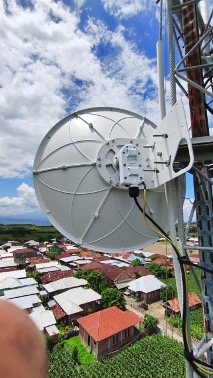
Indonesia’s unique geography creates major obstacles for broadband expansion. Many communities are separated by water, rugged terrain, or remote landscapes that significantly increase the cost and complexity of traditional fiber deployments.
In many of these locations, satellite connectivity has historically been the only practical option for network backhaul. However, satellite-based infrastructure often introduces higher latency, lower throughput, and ongoing operational expenses that can limit service quality and scalability.
Working together, AQN, Telkomsel, and Mimosa implemented a terrestrial wireless alternative designed to deliver improved performance while reducing deployment costs and accelerating time to service.
The deployment utilized Mimosa’s wireless backhaul platform to establish reliable point-to-point connectivity between aggregation sites and remote base stations. By leveraging unlicensed spectrum and streamlined deployment requirements, the solution enabled faster implementation without the delays associated with trenching fiber across remote terrain and waterways.
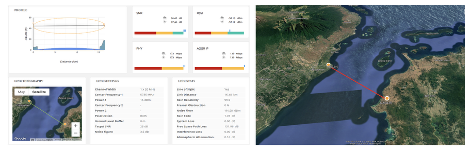
The deployment demonstrated strong performance across challenging over-water links while improving the end-user broadband experience in underserved communities.
As Indonesia continues expanding broadband access across rural and remote regions, flexible wireless infrastructure plays an increasingly important role in complementing traditional wired networks. Solutions that can be rapidly deployed and economically scaled help operators extend connectivity into areas where fiber may not yet be feasible.
This project highlights how fixed wireless backhaul can help bridge connectivity gaps, improve service delivery, and support long-term digital inclusion initiatives across geographically challenging environments.
Experience the perfect balance of performance and price with the new Mimosa C6x Lite Edition — built for today, ready for tomorrow.