Experience the perfect balance of performance and price with the new Mimosa C6x Lite Edition — built for today, ready for tomorrow.

Network Orbiter successfully deployed the Mimosa B6x wireless backhaul platform with the Orbiter OANT30-6SD-X high-gain antenna to deliver reliable, high-capacity connectivity across a 51.88 km link operating in a heavily congested RF environment. The deployment demonstrates how the right combination of radio performance, antenna design, and frequency planning can maintain carrier-grade performance where traditional wireless links often struggle.
Building reliable long-distance wireless backhaul becomes increasingly difficult in areas with high RF congestion. Network Orbiter set out to validate whether a wireless link could deliver consistent throughput, stable modulation, and reliable connectivity across a 51.88 km path despite significant interference.
The deployment paired the Mimosa B6x point-to-point radio with the Orbiter OANT30-6SD-X high-gain dish antenna, leveraging 160 MHz channels, precise antenna alignment, and optimized frequency planning to maximize spectral efficiency and link performance. The result was a stable, high-capacity wireless backhaul connection capable of supporting demanding network applications even in a challenging RF environment.
The deployment required a wireless backhaul solution capable of:
Deployment Details
Despite operating in a heavy interference zone, the deployment successfully delivered:
Despite operating in a heavy interference zone, the deployment successfully delivered:
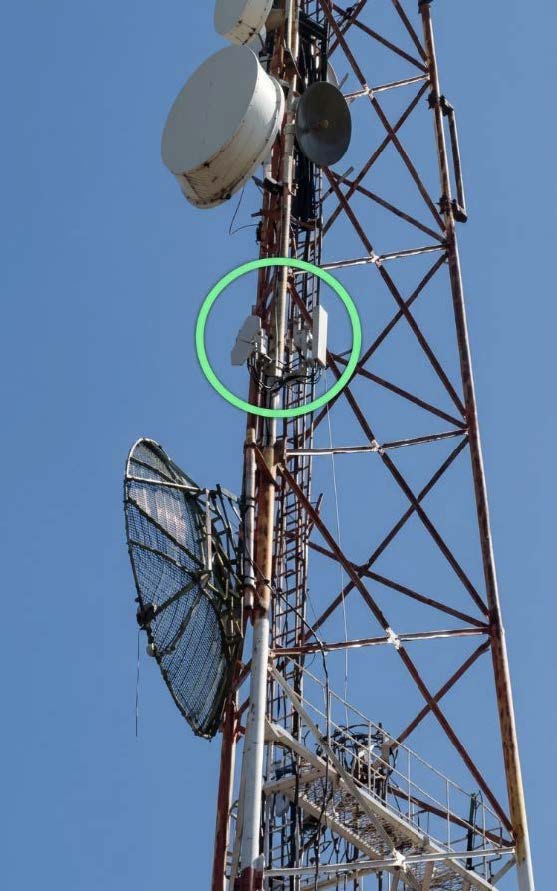
As wireless networks continue to expand, operators increasingly face deployments where spectrum congestion—not distance—is the primary challenge. This project demonstrates how combining the Mimosa B6x wireless backhaul platform with a high-performance directional antenna enables reliable, carrier-grade connectivity even in heavily interfered environments.
Rather than sacrificing throughput or link stability, the deployment maintained consistent modulation, low latency, and nearly 1 Gbps of Wireless MAC throughput across a 51.88 km path. The results highlight the importance of pairing advanced wireless radios with the right antenna and deployment practices to maximize spectral efficiency and network reliability.
For service providers, utilities, enterprises, and critical infrastructure operators, this deployment provides another example of how fixed wireless can deliver fiber-like backhaul performance while reducing deployment cost and accelerating network expansion.
Experience the perfect balance of performance and price with the new Mimosa C6x Lite Edition — built for today, ready for tomorrow.