Mimosa Podcast #42: Mimosa 5 Series Point-to-Point (PTP) Radios, Antennas, Adapters and More
Whether you're deploying point-to-point links for ISPs, enterprise networks, or public safety applications, these radios offer unmatched reliability and throughput.
But that's not all – we're also excited to unveil our new 30 dBi dish antenna, raising the bar for long-range connectivity. Discover how this high-gain antenna empowers operators to extend their reach and overcome challenging deployment scenarios with ease.
Tune in to this episode for exclusive insights from our experts, as they delve into the features, benefits, and real-world applications of Mimosa Networks' 5-Series products. Whether you're a seasoned network engineer or a newcomer to wireless technology, there's something for everyone in this must-listen podcast episode!
Don't miss out – hit that play button now and join us on the journey to wireless excellence with Mimosa Networks! 🔗 #MimosaNetworks #MimosaTechTalkPodcast #WirelessInnovation #PointToPointRadios #DishAntennas #connectivitysolutions
Listen to podcast:
https://soundcloud.com/mimosa-networks-techtalk
Key Takeaways
- Point-to-point wireless can act like a long-distance Ethernet connection between two locations without requiring copper or fiber.
- The Mimosa B5x supports more channel configurations and higher throughput than the C5x, including 2x80 MHz operation and speeds above 1 Gbps.
- The C5x offers a more cost-effective point-to-point option with throughput up to approximately 750 Mbps.
- Both the B5x and C5x feature rugged die-cast aluminum construction and IP67 weather protection.
- Mimosa's Twist-on antenna system allows operators to select different antenna gains and beamwidths depending on distance, interference, and deployment requirements.
- Wider-beam antennas such as the X12 and X16 can work well for shorter links and low-profile installations, while higher-gain dishes such as the X20 and X25 provide narrower beamwidths for longer links.
- Properly peaking and aligning the signal at both ends of a point-to-point link is important for maximizing performance.
- Mimosa's new 30 dBi antenna expands the 5 Series platform for longer-distance point-to-point deployments.
- The 30 dBi antenna uses a modular, petal-style design that reduces shipping size and simplifies packaging.
- Twist-on adapters can turn B5x and C5x radios into connectorized radios that work with compatible third-party antennas.
- Reusing already-installed antennas with Twist-on adapters can reduce installation costs and eliminate unnecessary tower work.
- Antenna polarity should match at both ends of the link to avoid signal loss and achieve optimal performance.
- Operators should always configure transmit power and antenna gain according to the wireless regulations in their country.
Transcript
Transcript
Dustin Stock: Hello, and welcome to Mimosa Tech Talk, a podcast by Mimosa Networks. We're on episode number 42 today. I'm your host, Dustin Stock.
Eric Thompson: And I'm Eric Thompson.
Dustin Stock: We'll be talking about Mimosa 5 Series point-to-point radios. We'll be talking about antennas, adapters, and more. So Eric, what does that mean? What is point-to-point? What is backhaul?
What Is Point-to-Point Wireless?
Eric Thompson: Point-to-point and backhaul are generally the same thing. It's kind of a wireless bridge. Think of it this way: if I need to connect two points, say from the fire station rooftop to a mountain a couple of miles away, or across the street, instead of running copper line or fiber, why don't we send the data through a wireless bridge or two radio points? PTP and backhaul are essentially the same thing.
Dustin Stock: So basically a very long Ethernet cable, depending on how much distance you have.
Eric Thompson: Yeah. If you can get the speeds, why not just send it wirelessly over the air?
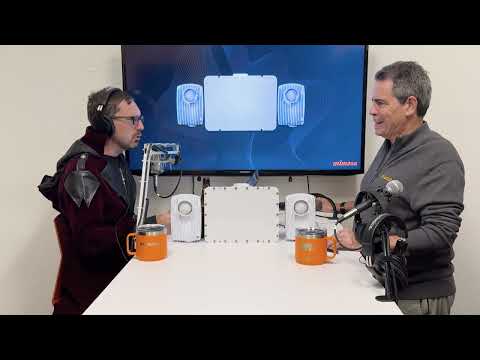
Dustin Stock: Right. Great. We want to highlight our 5 Series point-to-point radios today. For those who are watching, we have the B5x on the left-hand side of the screen and the C5x on the right-hand side. For those who can't see us and are just listening, the B5x is not a very large radio, but it's bigger than the C5x. It's got a Twist-on port, and the C5x has a Twist-on port as well.
Mimosa B5x
Dustin Stock: Let's talk about the B5x. It's a 1 Gbps-plus wireless radio using Auto-TDMA mode. It does 2x80 MHz channels, but you can also do 1x80, 1x40, 1x20, 2x20, or 2x40, so you have a lot of different options depending on the noise that you have.
We also have Auto Channel, which you can turn on and let the radio pick a good channel or change channels as needed when interference is introduced on a link. We have GPS for collocation, so with GPS timing and TDMA, you get the best performance possible. And of course, it's made out of die-cast aluminum, so it's a very rugged design. It's IP67-rated.
Eric, do you have anything you want to add about the B5x?
Eric Thompson: Sure. The B5x comes with an IP67 Ethernet gland, so that's weatherized. It also has a little rubber boot in there, keeping moisture, insects, and things out of the port.
It has an onboard native horn, which is also weatherproofed and IP67-rated, so you can use this right out of the box once it's unlocked. However, the beamwidth is pretty broad, so generally we like to mitigate noise and clean things up. We offer the X12, X16, X20, and X25 antennas for mid- and longer-distance applications, which we'll show you in a couple more slides.
Dustin Stock: What would you say the beamwidth is on that?
Eric Thompson: I think it's around 48 or 54 degrees with the built-in antenna as it comes out of the box. It's pretty wide.
If you have a couple of these collocated, like Dustin mentioned, using TDMA with GPS, maybe you have two, three, or four of these at a single location. You want to tighten up that beamwidth. We recommend something like an X25. That's our 18-inch dish with 25 dBi gain. It's good for mid- to long-distance applications, tightens the beamwidth down to around 12 degrees, and cleans things up quite a bit.
Dustin Stock: Right. So while you can operate this without a dish at short-range distances, I personally don't recommend that. If you want to do a really cheap installation, sure, but at the end of the day you want to make sure your customers have a high-quality connection, so using an antenna of some kind would be preferred.
Mimosa C5x
Dustin Stock: It's the same thing for the C5x. The C5x is the lighter, more cost-effective version. You can do up to 750 Mbps using Auto-TDMA mode. It's a one-channel radio, so you can do 1x80, 1x40, or 1x20. It's basically half the power of the B5x.
But this is one of Mimosa's top sellers, and not just in the U.S. market. In South America, the Middle East, and Asia, we have over 500,000 of these radios alone unlocked around the world because people love this product so much.
It's also made out of die-cast aluminum and is IP67-rated as well. For those of you who have used Mimosa for a long time, you might remember the C5x having the plastic door on it, and it was IP55-rated. We of course know that's not usable for a lot of people around the world, especially those near the beach or in really wet or temperate climates, because you're going to get water or moisture in there.
Eric Thompson: Yeah, so it's been nicely upgraded to IP67 with the IP67 gland. I guess we should also mention that it can be unlocked as a point-to-point radio, but the radio has versatility. It's also a PTMP, point-to-multipoint, client radio with a Mimosa access point. But more on that in another podcast.
Dustin Stock: Absolutely. We'll cover that in another podcast for sure.
5 Series Twist-on Antennas
Dustin Stock: You mentioned antenna sizes earlier. For those watching, we have an example of the 12 dBi horn and the 16 dBi horn here on the left-hand side, and then we have the 20 dBi dish and the 25 dBi dish.
In my personal experience, and I think a lot of WISPs out there probably gravitate toward the dish antennas over the horns, especially the 20 and 25 dBi here in the U.S. But I think the 12 and the 16 are very popular in Europe because people really desire low-profile installations.
The good thing with our radios is they're already small to begin with, so using a small antenna with a small radio makes it very low-profile. It's a very inexpensive installation, but you can still push a lot of speed across those links as well.
Eric Thompson: Right. Good point. Let's look at a 12 and a 16, for example. Those are going to have a very wide beamwidth, so the pattern is pretty wide. Depending on distance, it's a little more forgiving.
We still like you to peak your signal regardless of the dish you're using. And again, going back to point-to-point, it's absolutely imperative that you peak the signal on both ends of your link, regardless of the antenna used.
Dustin Stock: All right. Eric, do you have anything else you want to comment on before we move on?
Eric Thompson: As mentioned, we've got our 12 and 16, and once we go up to 20 and 25, we again narrow the beamwidth. These are likely our most popular antennas for point-to-point with the 5 Series Twist-on radios, providing tighter beamwidth patterns and supporting longer link distances.
But we're missing something very important here, aren't we?
Dustin Stock: We sure are. I have an idea what you're about to say.
The Mimosa 30 dBi Antenna
Dustin Stock: Before I move on, let's talk about the B5x again. It was first introduced to be a replacement for the B5. The B5 had a built-in 25 dBi dish, and of course we have the 25 dBi here, so it's perfect. If you needed a smaller dish or antenna size, we had that.
But a lot of people were looking for something larger, maybe 30, 32, 34, 35 dBi and up. When the B5c got discontinued, people were desperate for that. We're lucky that we have third-party vendors out there who have larger dish sizes, but people were looking for something from us.
So I'd like to introduce the Mimosa 30 dBi antenna. Some of you who have talked to me, Eric, or Jeff, who's not here on the show today, know we've mentioned the 30 dBi dish before. This is actually going up for presale within the next week or so from the recording of this show, and probably within a week of you initially watching this show. It should then be available sometime near the end of May.
People have been looking for a 30 dBi dish because 30 dBi antennas are a huge staple in the WISP market today. People are pushing 20 or 25 miles out of them.
Eric Thompson: Yeah, and more. Looking in kilometers, 60 or 80 kilometers is also typical for a 30-ish dBi dish.
Dustin Stock: But that really depends on the interference levels in your area and the transmit power. Some folks around the world who don't have to worry about FCC regulations can really crank that power up and push the distance on these radios.
I'm certainly not advocating for you to do that. If you're in a country that has regulations, please don't go against your regulatory body, because we don't want to get in trouble and we don't want you to get in trouble either.
Eric Thompson: And in the radio's user interface, you can keep track of some of these things. It'll calculate your EIRP. If you go in and say, "I want this transmitter power level, and I'm using a 25 dBi or a 30 dBi antenna," tally those numbers together and you get the EIRP. That's shown in all of our graphical user interfaces.
Dustin Stock: Eric, now that we're at the 30, do you want to pick it up real quick and show it off to the folks watching at home?
Eric Thompson: Sure.
Dustin Stock: Again, it's a 30 dBi dish. It currently supports the B5x and C5x for point-to-point. It's not listed here, and we'll go into this in a different show, but it also supports the C6x for point-to-multipoint as well.
It's easy to ship. It comes in pieces that Eric will talk about here, and of course it supports 4.9 to 6.4 GHz. Eric, let's go ahead and show it off.
Eric Thompson: There's the front. We can see the subreflector and the primary reflector. Let's bring it down a little bit. And here we'll show the rear.
We have a robust L-bracket. We kind of took our B5 bracket and beefed it up to accommodate the two-footer here. We've got the Twist-on port ready for your 5 Series radio, and currently it's shipping in packs of two.
Dustin Stock: Yeah, it will be shipped in packs of two right off the bat. Can you talk about the size of that pack?
Eric Thompson: I haven't seen the box itself. However, the excellent news is that the petals on the primary reflector come apart. These little pie-shaped pieces stack together, so that eliminates the need for a big box.
We've got our subreflector, full instructions on how to put it together, and it comes with the L-bracket ready to go.
Dustin Stock: To elaborate on what Eric is saying about it coming in individual pieces, basically in the box you have what he calls the petals. The pieces of the antenna are individually wrapped in plastic and stacked on top of each other, and those are wrapped in plastic as well, so everything is very well secured.
The mounting pieces and everything else are packed into the box. Everything basically comes apart. The subreflector screws onto the tube, and everything is modularized. It's all modular, and you screw it together.
So it goes very well with what we call our modular radios. It's all a nice package that goes together. We're excited to have that for folks out there shortly.
Twist-on Adapters for Connectorized Antennas
Dustin Stock: You know what else I'm excited about, Eric?
Eric Thompson: I know what you're excited about.
Dustin Stock: I'm sure people have been seeing these on the table here, but let's go ahead and talk about them. We're introducing Twist-on adapters.
These are exactly what they sound like. For example, we have a C5x here. You twist the adapter on, and it has effectively become a connectorized radio with two ports on it. This enables you to use any of the antennas that you already have that operate at 5 or 6 GHz.
We have a NetPoint adapter with N-type ports, a Telemart adapter that also uses N-type ports, and an ALGcom adapter that uses RP-SMA.
Regardless of where you are in the world, you have vendors who are willing to support you. NetPoint is in Mexico, ALGcom is in Brazil, and Telemart is in India. We have vendors located around the world with adapters that can help support your deployments.
This really opens up the B5x, the C5x, and future products to be more widely used and more versatile because you can use antennas you've already deployed. You don't have to pull down your antenna and put up the 30, a 25, or a 20 if you don't want to strictly use Mimosa products.
At the end of the day, you're a WISP. You have to try to save as much money as you can. If you already have antennas deployed on the tower and they're already aimed, you don't want to have to take those down and re-aim them.
Just put an adapter on for a low cost, screw it onto the radio, and you're good to go. Mount the radio, have your cables go into your antenna, and you're done. Easy as pie.
Again, we have ALGcom, NetPoint, and Telemart. It allows our Twist-on radios to become connectorized so you can use any antenna you want.
This is a picture I took in our back parking lot when I was actually testing these adapters. I personally tested each of these adapters, and they all work very well. There's almost no difference in performance. It's really whichever preferred vendor you want to use at that point. I'm not personally endorsing one over the other. They're all good.
Eric Thompson: A quick note as far as specifications. If you like to run slant 45 from your point-to-point radio, you can. We've got vertical and horizontal RF port feeds, so dual polarizations. We can place that straight up and down, vertical and horizontal, or we can twist it about 45 degrees and lock it down with the set screw on the B5x, C5x, and so forth.
We also help folks with this online through support. Both ends of the link should have the same polarity. If you've got slant 45 on one end of your link, you want slant 45 on the other. That will optimize the link and maximize performance.
If one side is conventional vertical and horizontal and the other side of the link is at 45 degrees, you could expect around 2 dB of loss. We want to make sure your polarity on both ends of the link is lined up, and you'll be in good shape.
Port isolation on these maxes out around 25 to 30 dB. Insertion loss, if I take this device and add it to the radio here, is no more than about a third of a dB. We also talk about good coax online and through support, and we can help you out with transmission-line jumpers, coax, and so forth.
Dustin Stock: Great. If you have nothing else to add, Eric, I think we've reached the end of our episode here. We'll catch you on the next Mimosa podcast.
Eric Thompson: All right. Thank you.
Dustin Stock: Thanks.